How to Check if Your Connecticut Property Has a Lead Service Line
A lead service line can be hard to identify because part of it may be underground, hidden behind a wall, or outside your property boundary. A water-quality test can help answer whether lead is present at the tap, but it cannot reliably identify the pipe that contributed it. Start with your water provider’s records, then confirm uncertain materials with a qualified professional.
What a lead service line is and why it matters
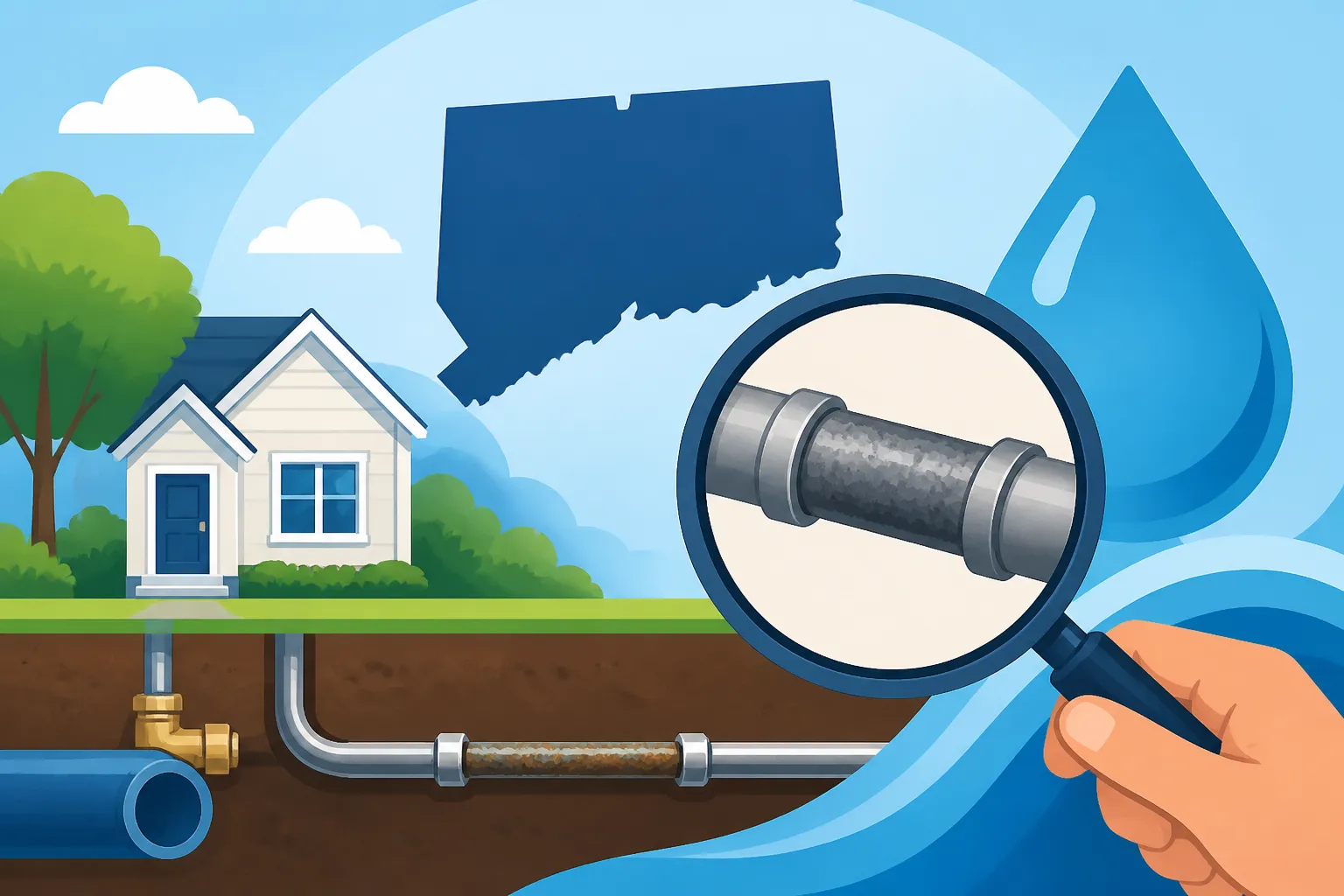
A service line is the pipe that connects a water main to a building’s plumbing. Depending on the property, it may run beneath a yard, sidewalk, driveway, or floor before entering the building. Some of it can be on private property and some of it may be in a public area. The location of a property boundary does not, by itself, tell you what material the pipe is made of or who is responsible for each section.
A service line can be made from different materials along its route. For example, a section near the street may not match the section where the pipe enters the building. That is why seeing a short length of pipe indoors—or finding a record for only part of the route—may not settle the question for the whole service line.
Lead can also be present in plumbing inside the building, such as pipes, solder, or fixtures. That creates an important distinction: finding lead in tap water does not automatically mean the service line is lead, and identifying a non-lead service line does not rule out other lead-containing plumbing.
If you are trying to assess the property, keep these questions separate:
- What material is the service line made of? This is a pipe-identification question.
- Is lead present in water from the tap? This is a water-testing question.
- Which part of the plumbing could be contributing lead? This may require more investigation than a single sample.
- Who is responsible for inspecting or repairing each section? The answer can depend on the line’s location, local rules, and provider procedures.
A service-line check is most useful when it addresses the whole connection and clearly identifies what is known, what is inferred, and what remains uncertain. If a record covers only the utility-owned portion, for example, ask whether the property-side portion has been checked too.
For background on pipe materials and why older plumbing can need closer attention, see Identifying Lead Pipes in Older Connecticut Public Water Connections. If you have received a notice saying that a line’s material is unknown, Unknown Service Line Notice: Is Your Tap Water Safe? explains why an unknown classification is not the same as a confirmed lead line.
Start by identifying the water provider for the property
Before looking for records, confirm which provider serves the address. A property owner may know the company from a bill, but tenants, buyers, and people reviewing a property remotely may not have that information. A lease, closing document, or prior water bill can be a starting point. If the water charge is included in rent or handled through a landlord, ask who supplies the water rather than assuming the property uses the provider serving a nearby building.
For a property connected to a public system, the provider is usually the most direct place to ask about the service-line record. If you do not know the provider, How to Find Your Public Water Supplier and Its Annual CCR in CT offers a way to begin narrowing that down. A water-quality report can help identify the system serving an address, but it is not necessarily a property-specific pipe inspection. Keep those records distinct.
When you contact the provider, give the full service address and ask for the response to be tied to that property. If you are buying or renting, clarify whether the answer refers to the current building, a nearby address, or a general neighborhood record. Similar street names, multi-unit buildings, and shared service arrangements can make informal answers easy to misapply.
It can help to ask the provider:
- Does the record cover the full service line from the water main to the building?
- Which portions of the line have been visually inspected or otherwise verified?
- What material is recorded for each portion?
- Is any portion listed as unknown or not yet verified?
- What evidence supports the classification?
- Is there a process for asking for a record review or an inspection?
- If the property has multiple units or service connections, which connection does the record cover?
Write down the date of the inquiry, the address you gave, and the name or department you contacted. Save any letter, email, portal result, or other record. If the answer is verbal, ask whether the provider can send the classification or supporting information in writing. A written record makes it easier to compare the provider’s information with an inspection, sale document, or later test result.
If a landlord, seller, or property manager is handling the request, ask for the original provider response rather than a summary alone. A summary can omit whether the entire line was checked or whether a portion is still unverified. That distinction matters when you are deciding whether a contractor’s inspection is still needed.
Check the provider’s service-line records
Public records can be a practical first step, but they are not a substitute for confirming what is present at a specific property. According to Aquarion Water, water systems must publicly inventory known lead service lines and document the lead status of other lines, including to “identify the locations of all known lead service lines.” Aquarion Water is not an official agency, so confirm the applicable inventory and classification with the official agency or water provider serving the property.
Look for a service-line inventory, address lookup, map, notice, or written response. The format varies, so an address may not appear in a simple search even when the provider has information about it. If an online record is not clear, ask the provider to explain the result instead of treating an absent entry as proof that the line is not lead.
Read the classification carefully. A record may distinguish between a confirmed material, a material that has not been verified, or a line made of more than one material. Do not treat “unknown” as “non-lead.” Likewise, do not assume a classification applies to every part of the service line unless the record says it covers the full connection.
| What the record says | What it can tell you | What to clarify |
|---|---|---|
| Lead is confirmed | The provider has classified the recorded portion as lead | Does the record cover the full line, or only a section? |
| A non-lead material is confirmed | The recorded portion has been classified as a different material | Has the entire service line been checked, including the property side? |
| Material is unknown or unverified | The provider does not have a confirmed material for that portion | What inspection or documentation could resolve the unknown status? |
| The line has mixed materials | Different sections may have different materials | Which material applies to each section, and where do the sections meet? |
| No result appears for the address | The online search has not provided a usable result | Is there a separate record, a different address format, or a connection not shown online? |
The wording of a record matters. A map pin can indicate a location without showing how much of the line was inspected. A record that identifies a material at the curb may not describe the pipe where it enters the building. Ask for the limits of the record, not just the label.
If the property is in an area served by Connecticut Water Company, How to Check Connecticut Water Company’s Service Line Inventory may help you understand what to look for. For a broader explanation of utility inventories, see Checking Public Water Service Line Material Inventories in Connecticut. These resources can help you interpret the kind of information you find, but the provider serving the address is the place to confirm the property’s actual record.
A provider’s inventory is also different from a water-quality report. An annual report describes water-system information; it does not establish the material of every individual service line or the plumbing inside a particular home. How to Read Your Connecticut Water Company Quality Report explains how to read a report without mistaking system-wide information for a property inspection.
Look at accessible pipe, but treat appearance as a clue
A visual check can help you understand what is accessible inside the building. It cannot show the parts buried underground or concealed by walls, and it should not be treated as a final identification if the material is unclear. If the pipe is hidden, inaccessible, painted, corroded, or covered by insulation, do not remove building materials simply to inspect it. Ask a qualified plumber or the water provider about an appropriate way to verify it.
If you can safely view where the service line enters the building, observe the pipe without scraping, cutting, sanding, or otherwise disturbing it. Avoid using a tool to expose a hidden section. Disturbing a pipe can damage it, and a small visible section may not represent the rest of the service line.
Keep a simple record of what you can see:
- Where the pipe enters the building.
- Whether the visible pipe appears to continue from outside or connects to another material.
- Whether there are joints, repairs, or transitions nearby.
- Whether the pipe is accessible enough for a professional to inspect.
- Which parts of the connection remain out of view.
Photos can help you explain the situation to a provider or plumber, but they are not proof of pipe material. Include context so the location is clear, and do not remove covers or panels if doing so could create a hazard or damage the building.
Do not assume that the pipe material visible indoors continues underground. A service line can change material along its route, and a repair or replacement may have affected only part of it. The reverse is also possible: a visible non-lead section does not establish what material is present outside. Ask the provider or plumber to say which specific sections they have identified.
A magnet or surface test may seem like an easy shortcut, but any do-it-yourself check should be treated as a screening clue rather than a definitive answer. It may not resolve a mixed-material line, a coated pipe, an inaccessible connection, or uncertainty about where one segment ends and another begins. Do not rely on a single appearance-based check when the result could affect a purchase, repair, or health-related decision.
If a professional inspects the line, ask what method was used, where the inspection began and ended, and whether the conclusion applies to the full service line. Ask for the result in writing. If a section could not be seen or verified, make sure the report says so rather than implying certainty about the whole connection.
Use a plumber or provider to resolve uncertainty
A provider’s records and a visual check may not answer every question. A licensed plumber can inspect accessible plumbing and advise on how to investigate a section that is hidden or difficult to identify. The water provider may have information about the section connecting to its main and may explain its own inspection or record-review process.
According to the U.S. Environmental Protection Agency, “Contact your water utility or a licensed plumber to determine” the service-line material. This is especially important when an inventory gives an unknown result, when the provider’s record covers only part of the line, or when visible plumbing does not clearly match the information on file.
When arranging an inspection, explain that the goal is to identify the service-line material, not only to check a fixture or test the water. Ask the professional to distinguish between the service line and interior plumbing in the findings. If the building has more than one unit or connection, confirm which line is being inspected.
Useful questions for a plumber or provider include:
- What parts of the service line can be inspected without disruptive work?
- Can the inspection identify each material transition along the route?
- What parts remain unobserved?
- Is the conclusion based on direct observation, a record, or an estimate?
- What would be needed to confirm an unknown section?
- Will the findings identify whether the conclusion applies to the full line?
- Who should receive a copy of the result?
If the professional cannot see the entire line, that does not make the inspection useless. It does mean the report should state the limits clearly. A partial inspection can narrow down what is known, while leaving an unresolved portion for follow-up with the provider or another qualified professional.
For buyers, coordinate the inspection with the people responsible for the property and ask how the result will be documented. For tenants, ask the landlord or property manager who will request the provider’s record and whether a plumber can inspect the accessible plumbing. Avoid arranging work on a service line without first understanding who is authorized to approve it.
Questions about responsibility can be separate from questions about material. A pipe may cross different property areas, and the allocation of inspection, maintenance, or replacement responsibilities depends on applicable arrangements and rules. Who Owns the Water Service Line Under Connecticut Law? can help frame that question. Confirm the answer for the particular property with the provider and, when needed, a qualified professional familiar with local requirements.
Understand what a tap-water test can and cannot tell you
A water test and a pipe inspection answer different questions. A tap-water sample can help determine whether lead is present in water collected from that tap under the sampling conditions. It generally cannot identify whether the service line, interior pipes, solder, or a fixture is the source.
According to the U.S. Environmental Protection Agency, a single tap-water lead test can show whether lead is present, but it generally cannot identify whether the source is the service line or other plumbing. The EPA recommends contacting the water utility or a licensed plumber to determine the service-line material. A test result should not be used as a substitute for checking the pipe itself.
A result showing lead does not, on its own, prove that the service line is lead. Lead could be coming from another part of the plumbing. A result that does not show lead in the sample is also not proof that the service line contains no lead; a sample reflects the water collected at that time and under the selected method. Discuss the meaning of a result with the laboratory, provider, or a qualified professional.
If testing is appropriate for your situation, use a laboratory and sampling procedure suited to the question you are trying to answer. Different sampling instructions can produce different kinds of information. Follow the laboratory’s directions rather than changing how long water sits in the pipes or how it is collected. Finding a State-Certified Laboratory for Home Water Lead Testing can help you identify what to check when selecting a lab, and First-Draw Tap Collections for Accurate Home Lead Lab Testing covers why sampling instructions matter.
Before ordering a test, decide what you need to learn:
- If you want to know whether lead is present in tap water, ask a laboratory about the appropriate sample and collection protocol.
- If you want to know whether the service line is lead, ask the provider or a licensed plumber to determine the pipe material.
- If you want to understand whether a particular plumbing component may be contributing lead, explain that question to the professional advising you and ask what evidence would help answer it.
- If you have received a provider notice, ask what the notice says about the service line and what follow-up is recommended.
A filter does not identify a pipe, and a pipe inspection does not provide a water-test result. If you are considering a filter, match its certification and stated reduction claims to the water test and the issue you are addressing. Do not assume that a product is suitable simply because it is marketed for lead. Testing Your Connecticut Tap Before Buying a Lead Filter explains how to connect a test result with a filter decision.
For health questions about possible lead exposure, ask your local health department or a medical professional. A water test or pipe inspection can help clarify the water or plumbing question, but neither is a medical assessment.
Decide what to do with a confirmed or unknown result
Once you have the provider’s record, inspection findings, or water-test results, keep each result attached to the question it answers. A clear record helps prevent a water test from being mistaken for a pipe identification or a partial inspection from being treated as a full-line confirmation.
If the service line is confirmed as lead, ask the provider what steps apply to the property and whether the recorded material covers the full connection. Ask the plumber or provider to explain what the finding means for any sections that were not inspected. Keep the written confirmation and any follow-up instructions with the property records.
If the service line is classified as unknown, ask what information would change that status. The provider may have a record-review process, or a plumber may be able to inspect accessible sections. Do not interpret an unknown classification as confirmation that the line is lead, but do not treat it as evidence that the line is free of lead either. It means the material has not been established in the record you have.
If the service line is confirmed as a non-lead material, check whether that classification applies to the entire line. Ask about interior plumbing separately if you have concerns, since the service-line result does not identify every pipe, fixture, or soldered connection in the building.
If a tap test detects lead, ask the laboratory or a qualified professional to explain the result and whether further sampling or plumbing investigation is appropriate. The test may not identify the source. If the result is concerning or you need advice about possible exposure, contact your local health department or a medical professional.
If the provider has sent a lead-related notice, read it in full and contact the provider with questions about the address, the recorded line material, and the recommended next steps. Got a Connecticut Lead Notice? When to Inspect or Test can help you think through follow-up questions. Do not assume that a notice applies to every unit or every pipe in a multi-unit property without checking the details.
For tenants, ask the landlord or property manager to share the provider’s written response and explain who will arrange any inspection. Keep copies of requests and replies. If the landlord’s response does not resolve whether the service line has been checked, ask the water provider directly about the information it can share with a resident.
For buyers, request the service-line record as part of the property information you review, and ask whether it covers the full connection. If the result is unknown or incomplete, discuss the gap with the appropriate inspection professional before making decisions based on an assumption. For owners preparing to sell, preserve provider responses and inspection reports so a future buyer can understand what was actually verified.
For any property, store the following together:
- The provider’s service-line classification and any explanation of what it covers.
- The plumber’s inspection report, including limitations.
- Laboratory reports and the sampling instructions used.
- Notices, follow-up requests, and written responses.
- Any records of repairs or changes to the service line.
These records are more useful when they identify the address, date, inspected area, and basis for the conclusion. If a later inspection finds a different material, the earlier documentation can help explain whether the line was repaired, whether only part of it was inspected, or whether the original record was incomplete.
Frequently Asked Questions
Does a water test tell me whether my service line is lead?
Not by itself. According to the U.S. Environmental Protection Agency, a single tap-water lead test can show whether lead is present, but it generally cannot identify whether the source is the service line or other plumbing. Contact the provider or a licensed plumber to determine the line material.
If the provider lists my line as unknown, does that mean it is lead?
No. An unknown classification means the material has not been established in the record. Ask the provider what information it has and what inspection or documentation could resolve the status.
Can I identify the full service line by looking at the pipe inside my home?
Usually not from a short visible section alone. Parts of the line may be underground or concealed, and the material can change along the route. Treat what you can see as a clue and ask the provider or a licensed plumber to confirm what it represents.
Does a non-lead service-line result rule out lead in my tap water?
No. A service-line classification answers a pipe-material question; it does not identify every part of the building’s plumbing or provide a tap-water test result. If you need to know whether lead is present in tap water, ask a laboratory about appropriate testing.
Who should I contact first?
Start with the water provider serving the property and ask for the service-line record and what portions it covers. If the material remains uncertain, contact a licensed plumber. For health questions, consult your local health department or a medical professional.
Sources
- Aquarion Water — Learn About Lead | Aquarion Water (checked November 14, 2026)
- U.S. Environmental Protection Agency — LCRI Questions and Answers (checked November 14, 2026)
Disclaimer
This article is for general informational purposes only and does not constitute professional advice. Laws, prices and regulations vary by location and change over time. Consult a qualified professional for guidance on your specific situation. Connecticut Water Guide is not a government agency or water utility and is not affiliated with any public water system.