How to Read Your Connecticut Water Company Quality Report
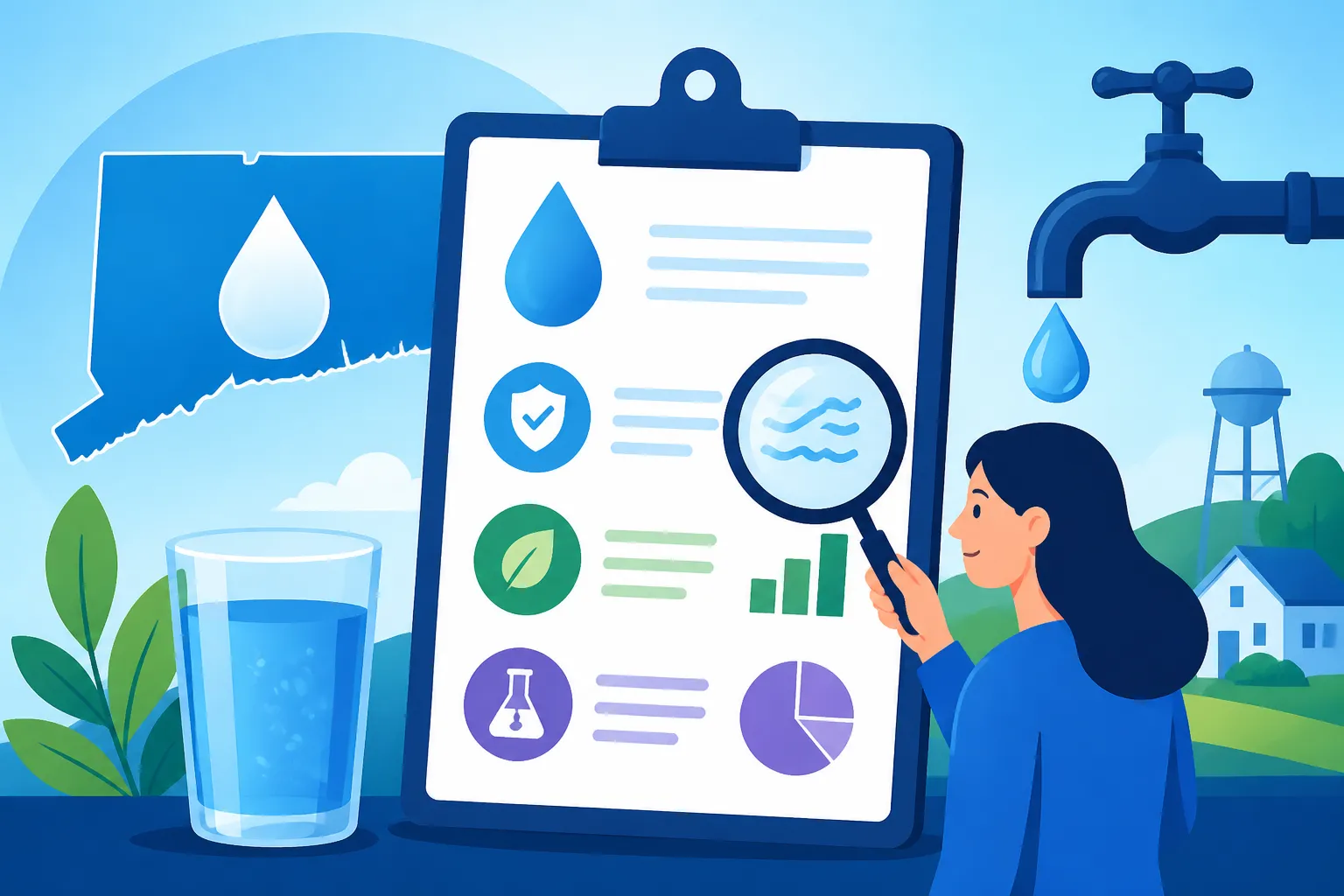
A Connecticut Water Company quality report can look dense, especially when it lists unfamiliar contaminants, units, and regulatory terms. The key is to confirm the report matches your service area, then read its results alongside the limits and sampling notes. This helps you understand what the utility tested, what it found, and what the report cannot tell you about water at your own faucet.
Start by finding the report for your service area
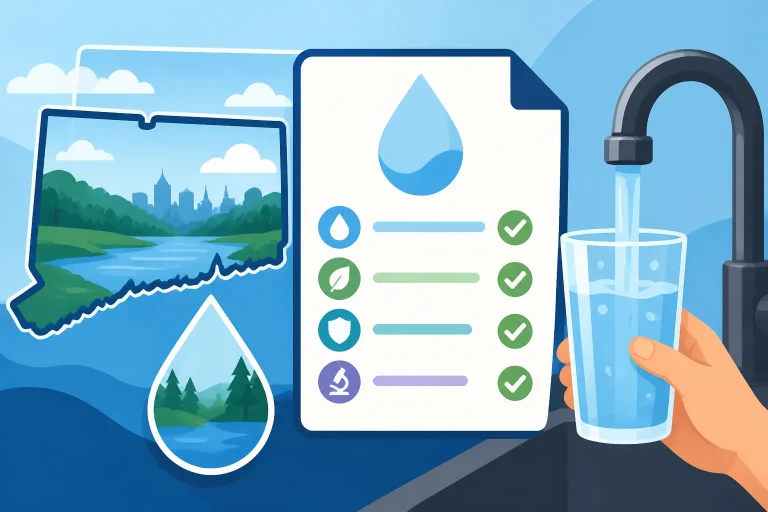
A water quality report is usually called a Consumer Confidence Report, or CCR. It summarizes water quality information for a public water system and a defined reporting period. Connecticut Water Company customers should use the company’s official website to locate the report that applies to their service address, rather than relying on a report found through a general search.
The same company can operate or supply more than one water system. The report that applies to one service area may not apply to another, even if both areas receive water from the same company. A report may identify a system by a name that differs from the company name or the name residents use for their town. That is why checking the service area matters before interpreting the numbers.
To identify the right report, use the address, account information, or service-area lookup provided by the company. If you are unsure which system serves your property, contact the utility using the current contact details on its official website. A town name alone may not be enough to identify the correct report, particularly near service-area boundaries or in places where multiple suppliers operate.
A renter who does not receive a water bill can check with the property manager or landlord, or use the address to ask the supplier which system serves the building. A private well owner should not use a public water system’s CCR as a substitute for well testing. The report describes a public system, not water drawn from an individual well.
For more help matching a report to an address, see Finding the Right Connecticut Consumer Confidence Report by Address and How to Find Your Public Water Supplier and Its Annual CCR in CT. If you already have a report but want broader context about what a CCR covers, What a Connecticut Water Quality Report Tells You About Your Tap explains the role of the report and its limits.
Before reviewing results, confirm three things:
- The supplier and system name: Does the report identify the system that serves your address?
- The reporting period: What calendar year or other period does it cover?
- The source or service area: Does the report describe the system supplying your neighborhood, rather than another part of the company’s network?
Reports are summaries, not live dashboards. A result in a report refers to samples collected during the period stated, under the sampling requirements that applied to the system. It does not necessarily describe today’s water conditions, every neighborhood equally, or the water after it has passed through your building’s plumbing.
Get oriented before reading the results
A CCR usually begins with a message from the water system, followed by information about water sources, testing, and results. It may also include explanations of terms, health information, system contacts, and notices about violations or other requirements. The order and design vary, so look for headings such as “Water Quality Data,” “Detected Contaminants,” “Source Water,” or “Definitions.”
Start with the reporting period and the system name, then scan for any section titled “Violations,” “Noncompliance,” or “Important Information.” A violation notice deserves attention, but it needs to be read in context: find out what requirement was not met, when it happened, how long it lasted, and what corrective action the system took or planned. A missed reporting or monitoring requirement is different from a test showing a contaminant above a limit. Both may appear in a report, but they do not mean the same thing.
Next, read the introductory notes explaining the sampling methods and terms used in the tables. Those notes can clarify why a result is shown as a range, a percentage, a 90th percentile, a maximum, or a single value. They may also explain that samples were collected at specific locations or that results cover a period different from the report’s publication date.
Many CCRs use a table with columns such as these:
| Table item | What it usually tells you | What to check |
|---|---|---|
| Contaminant | The substance or group tested | Whether the name includes a chemical abbreviation or a broader category |
| Units | How the result is measured | Whether the result and limit use the same units |
| MCL or other limit | A regulatory threshold, where applicable | Whether the report identifies the type of limit |
| MCLG or health goal | A non-enforceable health-based goal for some contaminants | Whether it differs from the enforceable limit |
| Highest level detected | A result selected or summarized under the applicable rule | Whether the table gives a range or a sampling explanation |
| Range of detections | The lowest and highest reported values, when provided | Whether the range includes several samples or locations |
| Violation | Whether the system did not meet a requirement | What the accompanying notice says about duration and response |
| Likely source | A general explanation of how the contaminant may enter water | Whether the entry describes a possible source, not a confirmed local cause |
The table is the most useful part for comparing results, but it should not be read in isolation. The footnotes often provide essential context. A result may have different units or a different calculation method from another result in the same report. A dash, “ND,” or “not detected” also has a specific meaning under the report’s testing and reporting rules; it does not necessarily mean the substance is impossible to detect at any concentration.
For a closer explanation of the standard report sections, see Understanding Eight Required CCR Elements in Connecticut. The best approach is to read the explanatory notes first, then use the table to find the contaminants and results that matter to your question.
Understand the source and treatment information
The source-water section describes where the system’s water comes from. Public water supplies may use surface water, groundwater, or a blend. Surface water includes water from reservoirs and other surface sources; groundwater is drawn from wells. A system may also use more than one source, or change its operating mix as conditions and system needs change.
A source description helps you understand the supply, but it does not by itself tell you whether the water is safe or unsafe. A source-water susceptibility rating, if included, describes vulnerability to potential contamination based on factors such as land use and source characteristics. It is not a test result showing that a contaminant is present in treated tap water. Likewise, a list of possible contaminant sources is general context, not proof that each listed activity has affected the water.
Treatment information describes steps taken to prepare water for distribution. Depending on the source and system, treatment can include filtration, disinfection, or other processes. A CCR may name treatment methods without explaining every operational detail. The report’s test results show the measured outcomes for the contaminants and sampling requirements it covers; a treatment description is not a guarantee that every possible substance was tested.
It also helps to distinguish source water from finished water. A result for untreated source water does not necessarily describe the water delivered to customers after treatment. Read the table headings and notes to see whether a result refers to source water, treated water, or water collected from distribution-system taps. If the report discusses more than one source or treatment plant, check which data apply to the system serving your address.
A system can also blend supplies or connect different parts of its distribution network. This means that the water delivered in one service area may not have exactly the same source mix as water elsewhere in the company’s system. The report’s system name and service-area description are useful clues, but the company is the best place to clarify how a particular neighborhood is supplied.
Use the report to answer practical questions:
- What kinds of water sources supply the system?
- What treatment steps does the report identify?
- Are the test results for the source, the treated supply, or distribution taps?
- Does the report identify a specific service area or source connection?
- Is there an explanatory note about blending, seasonal variation, or testing locations?
If a report says a contaminant was detected in source water but not in finished water, do not treat those entries as interchangeable. If the distinction is unclear, ask the supplier what the result represents and whether it applies to the water delivered to your area. For additional background on how reports relate to sources and treatment, see Connecticut Public Water Systems: Source Protection and Testing.
Read contaminant tables by comparing like with like
The numbers in a CCR are useful only when you know what each column measures. Begin by finding the contaminant name, result, units, and applicable limit. Then check the footnotes for the reporting method and sampling period. Do not compare a result with a limit until you have confirmed that they use the same units and refer to the same kind of measurement.
Know what detection means
A detected result means the laboratory reported a measurable amount under the method and reporting rules used. It does not automatically mean that the water violates a standard or presents a particular level of risk. For many regulated contaminants, systems must meet a specific limit, and the report shows results in relation to that limit. Other contaminants may have different reporting requirements or no enforceable limit shown in the table.
“Not detected” does not always mean absolutely zero. It generally indicates that the laboratory did not report the substance above the applicable detection or reporting threshold for that sample and method. The threshold and how results are presented can vary. If the report gives a detection limit or a footnote, use that information rather than interpreting “not detected” as proof that no molecule is present.
A range of detections can summarize results from multiple samples or sampling events. The highest value is not necessarily the typical value, and a single low value does not necessarily represent every sample. Read the sampling notes to understand how many samples were taken and how the reported summary was selected.
Match units before judging a result
Common units in water reports include milligrams per liter (mg/L), micrograms per liter (µg/L), and parts per billion (ppb) or parts per million (ppm). Some tables use counts, ratios, or other forms of measurement rather than a concentration. A smaller-looking number is not automatically a smaller amount if the units differ.
For example, a result reported in micrograms per liter cannot be compared directly with a limit shown in milligrams per liter without converting one of the values. Many reports put the result and limit in the same units, but verify this rather than assume. The footnotes may also explain how a result was rounded or expressed.
Understand the different kinds of limits
A CCR may list more than one benchmark. The most common terms include:
- MCL: The Maximum Contaminant Level, an enforceable limit for a regulated contaminant in public drinking water.
- MCLG: The Maximum Contaminant Level Goal, a health-based goal that is not an enforceable standard. It may be lower than the MCL.
- MRDL: The Maximum Residual Disinfectant Level, an enforceable limit for certain disinfectants.
- MRDLG: The Maximum Residual Disinfectant Level Goal, a non-enforceable health-based goal for certain disinfectants.
- Action level: A regulatory trigger for a particular type of response or action. It is not the same kind of standard as an MCL.
The report may include other benchmarks or explain a special calculation for a particular contaminant. Do not assume that every number in a “limit” column has the same legal or technical meaning. The report’s definitions section should explain the terms it uses.
Read “likely source” as background, not a diagnosis
A table may identify a likely source such as naturally occurring minerals, treatment processes, or runoff. These descriptions help explain how a contaminant can enter water. They do not necessarily identify the exact source of a result in a particular sample or prove that the contaminant came from a specific location.
A contaminant can be detected below an applicable limit, and the report may still list its possible source. Conversely, a result that is not detected does not mean every possible source has been eliminated. Treat these notes as context for interpreting the test, not as a complete map of environmental conditions.
If a table entry is unclear, write down the contaminant name, value, units, limit, and footnote, then ask the company to explain how those details fit together. The question “What does this result mean?” is easier to answer when you can point to the exact row and reporting period.
Distinguish a detection from a violation or a health conclusion
The word “detected” can sound alarming, but it is not the same as “exceeded a limit.” A detected contaminant may be below the applicable standard. A report may also show a result that requires a specific follow-up even when the table’s format is unfamiliar. The explanation depends on the contaminant, the sampling rule, the benchmark, and whether the system met the applicable requirement.
A violation means the water system did not meet a regulatory requirement. That requirement might concern a contaminant limit, monitoring, reporting, treatment, or another obligation. The report should provide a notice or explanation describing the issue. Read the notice rather than drawing a conclusion from the word “violation” alone.
When a notice appears, look for:
- The contaminant or requirement involved.
- The period when the issue occurred.
- Whether the issue involved a measured level, missed sampling, reporting, or another requirement.
- Whether the report says the system took corrective steps or is continuing follow-up.
- Whether customers were given specific instructions.
If the notice does not explain what customers should do, contact Connecticut Water Company through its official website for current information. For a broader explanation of how public systems communicate violations, see How Connecticut Public Water Systems Notify You About Violations.
A CCR is not a personalized health assessment. It gives system-level information and regulatory context, but it cannot determine what a particular person should do based on individual health needs. If you have a health question about a result, ask your local health department or a medical professional. If the report includes a specific advisory, follow the instructions from the water supplier and relevant public health authorities.
Also consider the time period. A report is published after data have been collected and reviewed, so it does not necessarily describe an immediate change in water quality or a current emergency. For urgent issues such as a boil-water advisory, use current notices from the supplier or local authorities rather than relying on an annual report. The report may explain routine monitoring, but it is not a substitute for emergency alerts.
Know what lead and copper results can and cannot tell you
Lead and copper information deserves careful reading because a utility’s monitoring results and an individual home’s water are not the same measurement. In many systems, lead and copper compliance monitoring uses samples collected at selected customer taps. The reported value may be a summary statistic, such as a 90th-percentile result, rather than a reading from every home or the highest result from every tap.
A 90th-percentile result is a way to summarize a group of samples. It does not mean that 90 percent of all homes have that exact concentration, and it does not predict the result at your faucet. The system’s sampling locations are selected under regulatory requirements and may not include every building type, plumbing arrangement, or household.
A result below an action level does not prove that every home has no lead or copper in its water. A result above an action level may trigger requirements for the system, but it still does not reveal the concentration in every customer’s home. The report’s sampling notes and any accompanying notices explain how to interpret the system-level number. For additional detail, see How Lead and Copper Units Differ on Connecticut Water Reports and How the 90th Percentile Lead Calculation Works in CT.
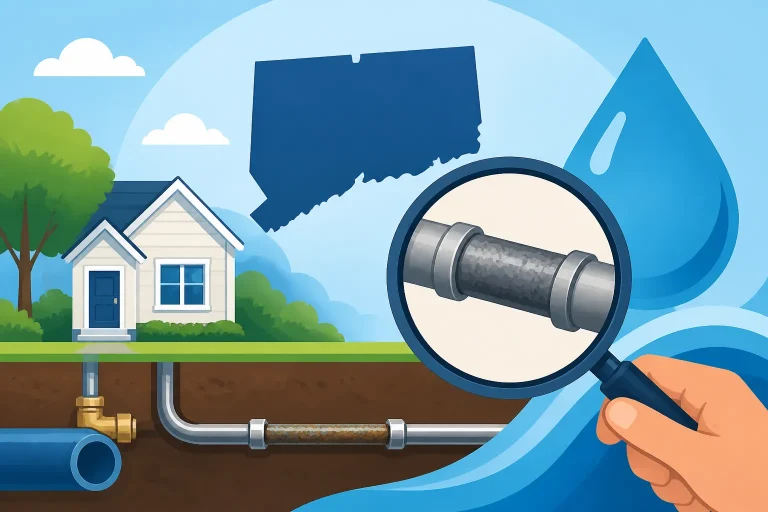
Lead can enter water from plumbing materials between the water main and the faucet, including service lines, solder, and fixtures. Conditions vary from building to building. Plumbing age, materials, water chemistry, and how long water has been sitting in pipes can affect a particular sample. This is why a CCR cannot confirm whether your own home’s pipes contain lead or what a sample from your kitchen tap would show.
If you have received a service-line notice or are concerned about plumbing in an older property, check the information specific to your address. How to Check if Your Connecticut Property Has a Lead Service Line explains how to investigate the service line, while Does Your Annual Water Report Reflect Your Specific Home Faucet? covers the difference between system data and a household sample.
For a home-specific question, ask the supplier what testing or guidance is appropriate. If you arrange a tap-water test, use a laboratory and sampling procedure suited to the question you are trying to answer. Lead testing can depend on how long water has remained in the plumbing and which tap or sample volume is collected. Changing the procedure can make results difficult to compare. See Finding a State-Certified Laboratory for Home Water Lead Testing for information on choosing a lab.
A filter should not be selected based only on the presence of a lead result in the CCR. First determine whether the concern is a system-level result, a service-line material, or a home-specific test. If you consider a treatment product, check its certification for the contaminant of concern and make sure that certification matches your test result and intended use. No filter claim replaces finding out what is present in the water you plan to treat.
Use the report for questions about your own tap
A report is a strong starting point for understanding the public system, but it has limits. It generally does not test every possible contaminant, every street, every building, or every household faucet. It also cannot account for plumbing inside a home or apartment. A building’s pipes, fixtures, hot-water system, and periods of water stagnation can all make its tap water different from the water sampled elsewhere in the system.
That does not make the report unhelpful. It tells you which system serves the area, how the supply is described, what regulated testing found, and whether the report identifies a violation or required action. Use it to form a more specific question rather than treating it as a complete test of your home.
If the report omits a detail you are looking for, consider the following:
- Hardness: Hardness may not be included in a CCR because it is not necessarily part of the report’s required regulated-contaminant table. Ask the supplier whether it publishes hardness information or check a suitable test. Finding Water Hardness When Your Connecticut Water Report Omits It explains how to approach that gap.
- A taste, odor, or color change: An annual report may not explain a recent or localized change. Check for current utility notices and ask the supplier whether there is work, flushing, or another known issue in your area.
- A contaminant not listed in the table: Absence from a CCR does not by itself show that the substance was tested and not detected. It may not be part of the table or monitoring requirements for that system and period. Ask the company what testing information is available.
- A specific home’s plumbing: The report cannot identify the materials inside your building. For a building-level concern, investigate the plumbing and consider an appropriate tap sample.
- A private well: A public system report does not apply to a private well. Well owners need testing designed for the well and local concerns.
When you contact the company, make the question concrete. Include the service address or system name, the report period, and the contaminant or table entry you are asking about. Useful questions include: “Does this report apply to my address?” “Is this result from source water or treated water?” “What does the footnote mean?” and “Is there a more recent notice for my service area?”
For a useful personal record, save the report and note the date you reviewed it. If you are comparing reports over time, compare the same system, contaminant, units, and measurement type. A change in a number may reflect a real change, a different sampling method, a different sampling set, or a reporting format. Ask the supplier before treating a difference as a trend.
The most reliable reading is both careful and limited: use the report to understand the public water system, but do not ask it to answer questions it was not designed to answer. For a home-specific concern, identify the source of the concern and choose a test or next step that addresses it.
Frequently Asked Questions
Where can I find the Connecticut Water Company report for my address?
Use Connecticut Water Company’s official website to locate the report for your service area, or ask the company which system serves your address. Do not assume that a report for a nearby town or another company system applies to your property.
Does a detected contaminant mean the water violated a standard?
No. A detection means the laboratory reported a measurable amount under the applicable method. Whether it is a violation depends on the contaminant, the relevant limit or requirement, and the results and sampling rules described in the report.
Does the report prove my home’s tap water has the same quality?
No. A CCR summarizes information for a public water system. It does not test every home faucet or account for the plumbing inside a particular building.
What should I do if the report lists a violation?
Read the notice for the requirement involved, the time period, and any customer instructions. If the explanation is unclear or you need current information, contact Connecticut Water Company through its official website. For health questions, contact your local health department or a medical professional.
Disclaimer
This article is for general informational purposes only and does not constitute professional advice. Laws, prices and regulations vary by location and change over time. Consult a qualified professional for guidance on your specific situation. Connecticut Water Guide is not a government agency or water utility and is not affiliated with any public water system.