What a Connecticut Water Quality Report Tells You About Your Tap
A water quality report can look technical while leaving the most practical question unanswered: what does it mean for the water at your kitchen tap? The key is to match the report to the right supplier, understand what its results describe, and recognize where system-wide data may not answer a home-specific concern.
What a Connecticut water quality report is designed to explain
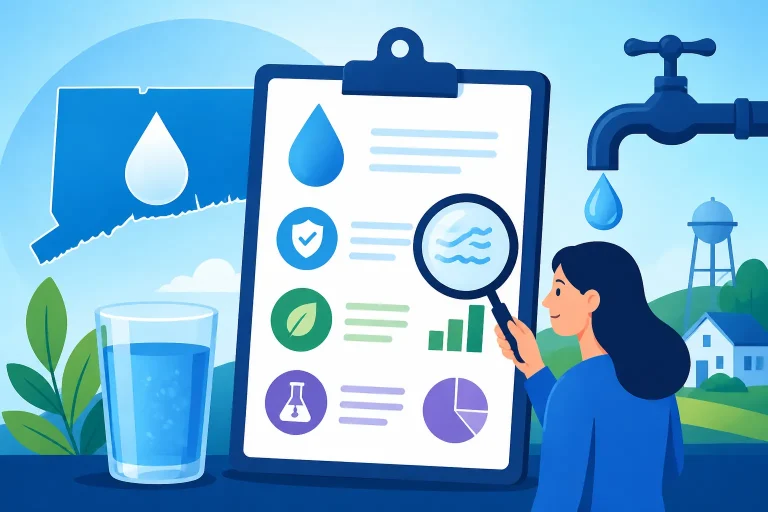
The Connecticut Department of Public Health describes a Consumer Confidence Report (CCR) as an annual report about the quality of water delivered by a community water system and risks from detected contaminants. In other words, it is a summary of information about a public water system’s supply, not a test of the water at every faucet connected to it.
That distinction is central to reading the report. A CCR can help you understand what the system monitors, what it detected, and how the results compare with the benchmarks or explanations printed in the report. It can also point you toward further questions. But it does not automatically describe the plumbing inside your building, the condition of your service line, or the water in a particular glass.
Think of the report as a map of the system’s water quality information. It can show what the system’s monitoring found and help you decide what to investigate next. A map is useful only if you have the right one, though, and it cannot tell you everything about the final stretch from the water main to your tap.
Reports can use terms that sound similar but mean different things. A detected contaminant is something found in a sample; detection alone does not tell you how to interpret the result. A reported level gives the measured amount, while a comparison value or explanatory note gives context for interpreting it. A violation notice, if the report includes one, describes a compliance issue the report identifies. Read the result alongside its units, comparison information, notes, and any explanation of what the system did.
The report is not a substitute for a health assessment tailored to a person or household. If you have a health concern about drinking water, ask the Connecticut Department of Public Health or a medical professional. If the concern is about your particular tap, plumbing, or service line, you may need information beyond the CCR.
For help finding the right document, see How to Find Your Public Water Supplier and Its Annual CCR in CT. If you know that your supply is from the Metropolitan District, How to Find Your MDC Water Quality Report may help you locate the relevant report.
Make sure the report applies to your address
Before interpreting any table, check whether the report covers the water supplier serving your home. A report can be accurate and still be the wrong report for your address. Connecticut residents may encounter different suppliers across nearby towns, neighborhoods, or buildings, so a town name by itself may not identify the correct system.
Start with the name of the supplier shown on your water bill, lease documents, or service information. If you do not receive a bill directly, ask the property manager or landlord which public water system serves the building. A renter may pay a landlord or have water costs included in rent, but that does not establish which supplier delivers the water. The report needs to match the system serving the property.
Check the report’s coverage description, not only its title. It may identify a system, service area, community, or set of water sources. Make sure the address or neighborhood falls within that coverage. A report for a supplier serving a nearby area is not a reliable substitute simply because the locations are close.
If you are unsure which document applies, confirm the supplier through official utility or agency information. For a more detailed route to identifying the relevant report, see Which CT Water Quality Report Applies to Your Neighborhood or System? and Finding the Water Quality Report for Your CT Water District.
Once you have the likely report, check the report period or issue information printed in the document. Because a CCR is an annual report, the document identifies a reporting period; make sure you are reading the intended report rather than an older copy or a report for another system. Do not assume a report is current just because it appears in a search result or was forwarded by someone else. If the supplier’s site offers more than one report, use the one that corresponds to the period you want to review.
A practical identification check looks like this:
- Does the supplier name match the system serving the address?
- Does the coverage description include the property’s service area?
- Does the report period match the document you intended to review?
- If a landlord or property manager supplied the report, have they confirmed that it applies to the building?
- If the supplier is unclear, have you checked with official utility information rather than relying on a neighboring property’s report?
If the report does not clearly identify whether it covers your home, contact the supplier through its official website and ask which report applies. Avoid drawing conclusions from a report until you have confirmed its coverage.
Read the report in a useful order
It is tempting to go straight to the contaminant table. Start with the introductory material instead. The opening pages can explain what the report covers, identify the supplier and water sources, and describe how to read the results. Those notes may answer questions that a table cannot answer on its own.
A useful reading order is:
- Confirm the supplier and coverage. Check the system name and the area described in the report.
- Read the opening explanation. Look for definitions of terms, units, comparison values, and notes about results.
- Review the water source and treatment descriptions. These can help you understand the context for later results, when the report includes them.
- Read the detected-contaminant information as a whole. Take in the contaminant name, measured result, units, comparison value, and any accompanying explanation.
- Check for notices or follow-up information. If the report describes a problem or action, read that section instead of interpreting the table entry alone.
- Note what remains unanswered. A system-level report may not resolve a question about plumbing, a particular faucet, or a specific household.
This order helps prevent a common mistake: seeing a value first and trying to interpret it without knowing what it measures or how the report presents it. A number without its units and context is incomplete. Even when a result looks familiar, the report’s own definition and comparison information matter.
Look for a glossary or explanation of technical terms. Reports may distinguish between a result for an individual sample, a summary of multiple results, a range, or another way of presenting monitoring information. The precise meaning depends on the wording and format in that report. Do not assume that a term has the same meaning across every table or contaminant category.
Pay attention to footnotes and symbols. A mark beside a result may refer to an explanation elsewhere in the document, a sampling detail, or a particular note about how to interpret the result. The note is part of the result, not optional fine print. If the report uses abbreviations, use its glossary or ask the supplier what they mean.
You can also use the report’s headings to form a short list of questions. For example: Which water source is described? What does this table’s unit represent? What comparison value is being used? Does the report explain a result or mention follow-up? Does any of this address the concern at my home? Clear questions make a conversation with the supplier or a qualified professional more focused.
For help understanding how a report is organized, How to Read Your Connecticut Water Company Quality Report offers a related place to start. If your question is about the structure and common report components, see Understanding Eight Required CCR Elements in Connecticut. The title includes a number, but when reading any report, rely on the actual contents of the document that applies to your supplier.
Understand the detected-contaminant information
A contaminant table can be the most consequential part of a CCR and the easiest part to misread. Read each entry as a set of connected details rather than focusing on the measured value by itself.
Start with the contaminant name. This identifies what the report is discussing, but it does not tell you why it might be present, what the result means, or whether the report treats it as a concern. The report’s accompanying explanation and comparison information provide that context. If you are not familiar with a contaminant, avoid guessing from its name; ask the supplier or a qualified professional what the entry means.
Next, identify what the result represents. A table may present a measured level, a range, or a summary in a particular format. Look for the column heading and any note explaining how the result was calculated or reported. Do not assume that a summary value is the reading from a single tap, or that a value in one column represents the same thing as a value in another.
Then check the units. Units tell you the scale used to express a result. A result without its units cannot be compared responsibly with another value. If you are comparing information from different documents, confirm that the units and the type of result are compatible before drawing a conclusion.
Find the comparison value or standard that the report gives, if one appears. Read its label and the report’s explanation carefully. Do not treat every comparison value as interchangeable: a report may distinguish the purpose of one value from another. If the table includes a result and a benchmark, understand what each column means before deciding whether the result is below, near, or above the stated benchmark.
Read the notes about detections. A detection indicates that a contaminant was measured in the sample described by the report. It does not, by itself, explain the significance of the result or establish the quality of water at a particular home. A detection should be interpreted using the report’s own context, including the stated comparison information and any explanatory note.
Look separately for any notice or compliance discussion. If the report describes a violation, a missed requirement, or a response, read that explanation carefully and follow the current information provided by the supplier or the Connecticut Department of Public Health. Do not infer that an ordinary detection is a violation, or that the absence of a violation means a particular household has no plumbing-related concern. These are different questions.
A careful review can be summarized in a table:
| Report detail | What to check | Why it matters |
|---|---|---|
| Contaminant name | Confirm which substance the entry refers to | Similar-sounding terms may refer to different things |
| Result | Identify whether it is a measurement, range, or summary | The format affects how the result should be understood |
| Units | Read the unit beside the result | Values cannot be compared responsibly without compatible units |
| Comparison information | Read the label and explanation attached to the benchmark | Different comparison values can serve different purposes |
| Notes and footnotes | Follow references to explanations elsewhere in the report | Important qualifications may be outside the main table |
| Notice or response | Read the explanation and any follow-up information | The report may describe a system action that a result alone does not show |
| Sample context | Check what the report says about where or how samples were collected | System monitoring is not the same as testing your own faucet |
If the report’s table is hard to follow, write down the exact entry and ask the supplier to explain the result, units, comparison value, and any notes. Asking about the complete entry is more useful than asking whether a single number is “safe,” because the answer depends on what the number represents and what comparison the report uses.
Learn what the report can and cannot tell you
A CCR is useful for understanding information about water delivered by the community water system identified in the report. It can help you see what the report says about detected contaminants, the supplier’s water sources, and explanations or notices included with the results. Its value depends on using the correct report and reading its context, rather than treating a table as a complete assessment of every tap.
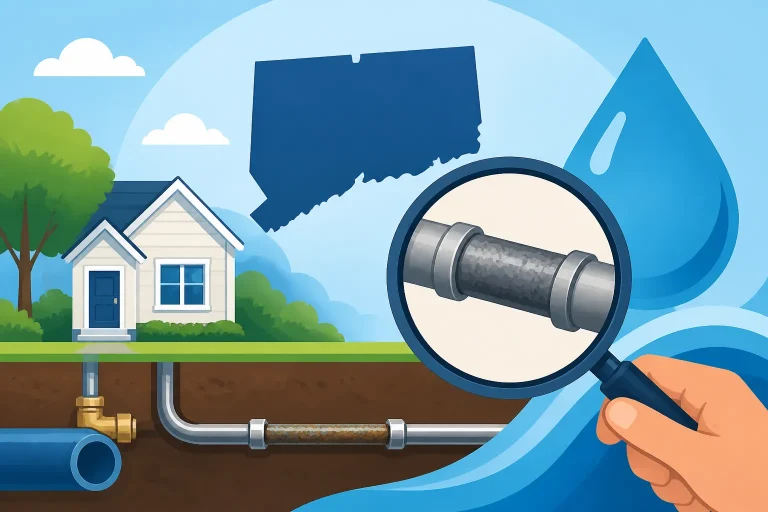
The report does not necessarily describe the water after it has passed through your property’s service line and indoor plumbing. Pipes, fittings, fixtures, and conditions within a building can affect what comes out of a particular faucet. The CCR is not a substitute for checking the material of a service line or testing water from a specific tap when that is the concern.
This matters especially when the issue is lead. A system-wide report may not answer whether a particular property has a lead service line or whether household plumbing contributes lead to tap water. For property-specific questions, see How to Check if Your Connecticut Property Has a Lead Service Line and Does Your Annual Water Report Reflect Your Specific Home Faucet?. If you received an unknown service line notice, Unknown Service Line Notice: Is Your Tap Water Safe? can help clarify what that notice does and does not establish.
The report also does not prove that every possible contaminant was included in the results shown. Read the report’s description of its monitoring and tables to understand which information it presents. Do not treat the absence of a contaminant from a table as proof that it was tested for or absent from every location. If you need to know whether a particular substance was included, ask the supplier or a qualified laboratory about the testing information relevant to that question.
A report’s results also have a defined context. They relate to the system, sampling information, and reporting period described in the document. They are not a guarantee about future conditions or a direct measurement from your own faucet today. If you notice a sudden change in taste, odor, appearance, or pressure, do not rely on an older report to explain it. Check current supplier notices and seek guidance about the specific change. Sudden Odor or Taste Changes in Connecticut Tap Water: What to Check covers practical steps for that kind of concern.
Finally, the report is not a personal medical assessment. It does not determine how an individual should respond to a particular result or condition. If you have a health question, contact a medical professional or the Connecticut Department of Public Health. If you need a property-specific answer, identify the right sampling or inspection path rather than trying to make the CCR do more than it can.
A useful boundary to keep in mind is:
- The report can help with: understanding information the supplier reports about its delivered water and detected contaminants.
- The report may not answer: what is happening inside your building, at an individual faucet, or in a specific service line.
- The report cannot replace: current utility notices, property-specific investigation, relevant testing, or individualized health guidance.
Use the report to decide what to do next
The best next step depends on the question you are trying to answer. A general curiosity about source water calls for a different follow-up than a lead concern at a kitchen faucet or a sudden change in tap water. Before taking action, state the concern as specifically as possible.
If you are checking whether the water system has reported a particular contaminant, locate the corresponding entry and read the full row, notes, and explanation. If the report is unclear, ask the supplier to explain the result and how it relates to the comparison information in the report.
If you are trying to identify the water source or treatment described, read the relevant section and ask the supplier to clarify any terms. The report can provide background, but a general description of the system is not a direct measurement of the water at a particular home.
If you are concerned about a specific tap, establish whether the question relates to the public water system or the property’s plumbing. A report may not distinguish between those possibilities. Depending on the concern, a property-specific sample or inspection may be more relevant than another system-wide document. Use an appropriate qualified professional or laboratory when testing is needed, and follow the sampling instructions for the test being performed.
If the concern is hardness, do not assume that the CCR will include a hardness result. If the report omits it, check supplier information or consider a suitable test before choosing treatment. Finding Water Hardness When Your Connecticut Water Report Omits It explains how to approach that gap.
If you are considering a filter or treatment system, use the test result or supplier information to identify what you actually want reduced. A filter’s name or general marketing description is not enough to show it is appropriate for a particular contaminant. Check whether the product is certified for the reduction claim you need and compare that certification with your own water test results. A treatment choice based on the wrong contaminant or unsupported assumptions can fail to address the concern. Choosing Certified Water Filters for Connecticut Homes and How to Match Connecticut Water-Test Results to the Right Filter can help you think through that decision.
If you have a notice or an active advisory, follow the supplier’s current instructions rather than relying on a general interpretation of an older CCR. For an advisory, Connecticut Boil Water Advisories: Procedures and Safe Use explains why current notice information matters. When you need contact details, use the official utility or agency website to find current information; do not assume details in an old document are still current.
A practical sequence for moving from report to action is:
- Name the question. Decide whether you are asking about system-wide results, your property’s plumbing, a particular tap, or a health concern.
- Confirm the report. Check supplier, service area, and reporting period.
- Record the relevant entry. Include the contaminant name, result, units, comparison information, and notes.
- Identify the gap. Decide what the report does not establish about your home or concern.
- Choose a suitable follow-up. Ask the supplier about system data, seek property-specific testing where appropriate, or consult a qualified professional.
- Recheck current information. Look for current supplier notices if the issue involves a change or advisory.
- Avoid buying treatment by guesswork. Match any filter or treatment claim to relevant test results and certification.
Keeping these steps separate prevents the common leap from “the report contains a result” to “I know exactly what is coming from my faucet.” It also helps you avoid the opposite mistake: assuming that because the report does not answer a property-specific question, it has no value. Used for the right purpose, a CCR is a useful starting point.
Common misreadings to avoid
Treating the report as a test of your home. The report concerns the water delivered by the community water system it identifies. It does not automatically show the condition of the water after it passes through your service line and indoor plumbing. For concerns about your own tap, look for property-specific information or testing that addresses that question.
Reading a result without its units. Units are essential context. A value by itself may be impossible to interpret or compare. Keep the result, its units, its column heading, and any explanatory note together when you ask for help.
Assuming that detection tells the whole story. Detection is only one part of an entry. The report’s comparison information, sample context, and explanation help determine how to understand it. Do not equate the word “detected” with a conclusion about risk or compliance.
Assuming that no table entry means no possible issue. A report only provides the information it presents. If a contaminant is not listed, check whether the report explains what monitoring it covers before assuming anything about that substance.
Using a report for the wrong supplier. Nearby properties may not share the same supplier or report. Confirm the system serving your address rather than relying on a neighbor’s document or a search result with a familiar town name.
Treating a system result as a prediction for every faucet. System-level results and water at a particular tap answer different questions. A home’s plumbing and service line can matter, so a general system report may not settle a household-specific concern.
Assuming treatment is needed because a report contains a technical term. The presence of a contaminant name in a table is not, by itself, a reason to buy equipment. First understand the reported result and determine whether it relates to your concern. If you consider treatment, confirm that the product is certified for the reduction you need and check that certification against your own test results.
Using an old report to respond to a current change. A CCR is an annual report, but a new odor, appearance change, pressure loss, or current advisory calls for current information. Check the supplier’s present notice rather than using an earlier report as an answer to a new condition.
Frequently Asked Questions
Does a Connecticut water quality report tell me exactly what is in my tap?
It describes information about water delivered by the community water system identified in the report. It does not necessarily show what is coming from a particular faucet after water passes through a property’s service line and indoor plumbing. A home-specific concern may require separate investigation or testing.
Does a contaminant detection automatically mean the water is unsafe?
No. A detection needs to be read with the report’s units, comparison information, sampling context, and explanation. If you have a health concern about a result, ask the Connecticut Department of Public Health or a medical professional.
What if I cannot tell which report applies to my home?
Confirm the supplier serving the address through official utility information. If you rent or do not receive a water bill, ask the landlord or property manager to identify the supplier, then verify that the report’s coverage includes the property.
Should I buy a filter based on the report?
Not from a contaminant name alone. First determine whether the result relates to your particular concern. If you consider a filter, check that it is certified for the reduction you need and compare the certification with your own water test results.
Disclaimer
This article is for general informational purposes only and does not constitute professional advice. Laws, prices and regulations vary by location and change over time. Consult a qualified professional for guidance on your specific situation. Connecticut Water Guide is not a government agency or water utility and is not affiliated with any public water system.